
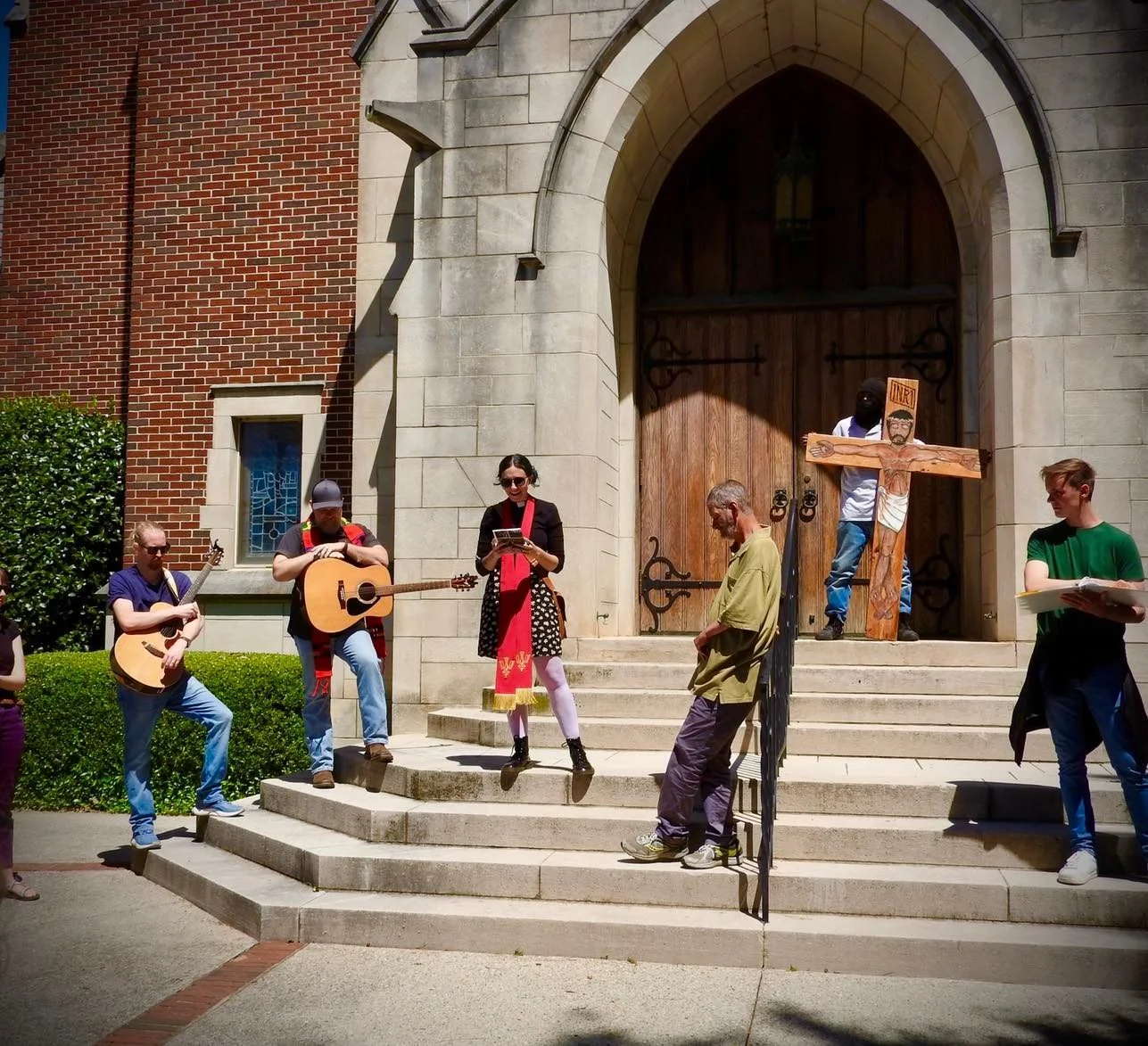
GOOD FRIDAY
Stations of the Cross, 2026
What does it mean to be poor in a rich city? Homeless in a neighborhood of mansions? Outcast on a street of churches?
What does it mean to follow Jesus—who was himself poor, homeless, and an outcast—and who stands with those who still suffer the same way today?
STOP 1
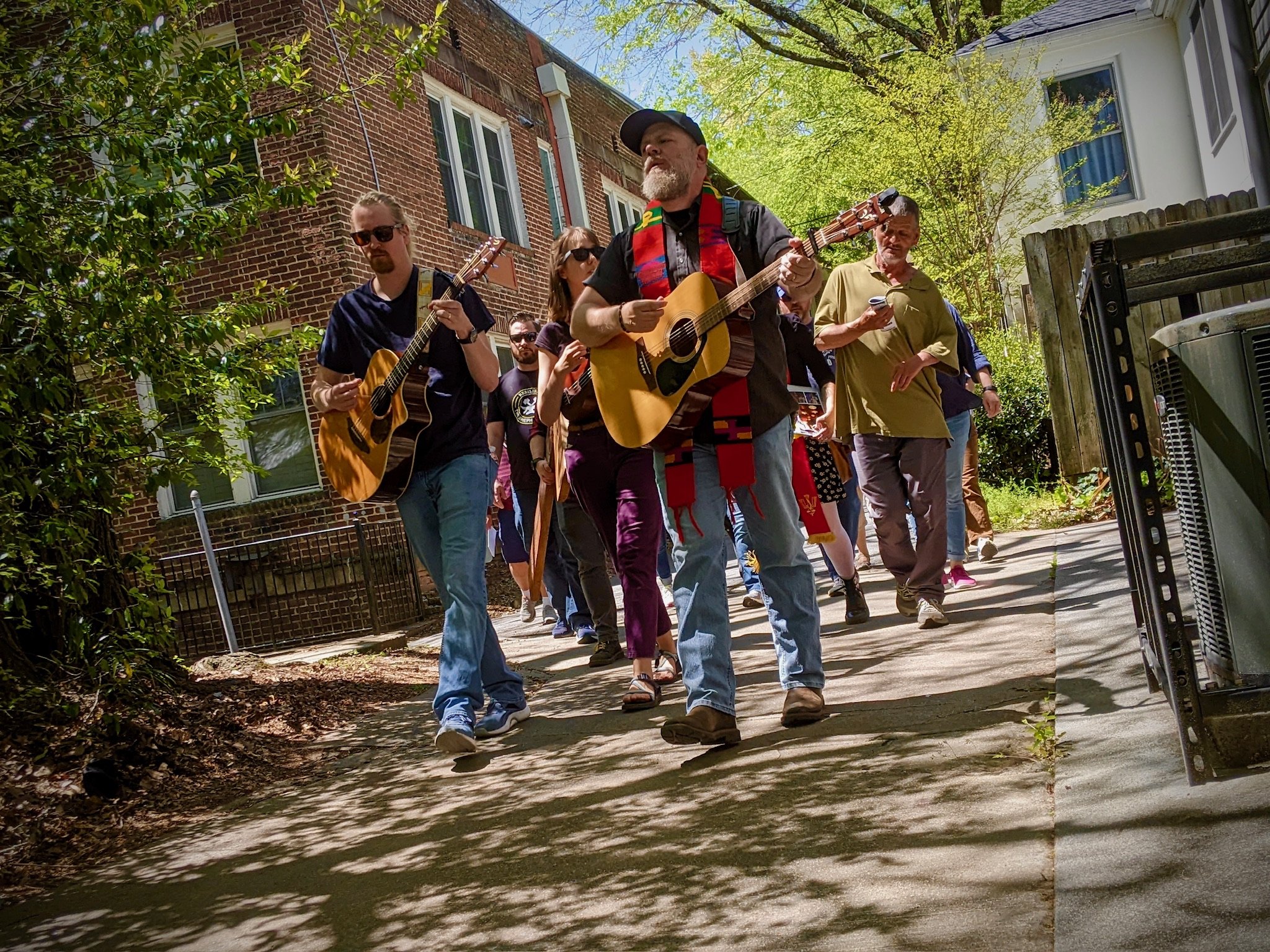
GATHERING TOGETHER
IN OUR NEIGHBORHOOD: Under the Tree, Parking Lot of DHPC
REFLECTION: Why We Walk
What does it mean to be poor in a rich city? Homeless in a neighborhood of mansions? Outcast on a street of churches? What does it mean to follow Jesus—who was himself poor, homeless, and an outcast—and who stands with those who still suffer the same way today?
On this holy day when we remember Jesus’ violent death at the hands of the state, we consider how the story of our God-made-flesh intersects with the lives of the poorest among us still. This walk is an act of worship–we’ll read scripture together and pray for one another. It is an act of remembrance, but also of protest, as worship often can be, wherein together we imagine and hope for a day when no more people will suffer and die an untimely death at the hands of power.
This service is an adaptation of the Stations of the Cross, a beautiful tradition that helps us to remember Jesus’ death with our bodies. Today, however, we will not be performing the stations of the cross in simply a traditional sense. In sharing our own stories as we walk through the streets that so many of us call home, we recognize where Jesus stands alongside us, and we name the ongoing crucifixion of the poor. In gathering together and remembering Jesus’ story, we claim God’s presence amid our stories, too.
The walk we embark on today has a history in our community–in many ways it tells the evolving story of our little church. While we have been making this walk for many years now, stops have changed, just as our community has. Over the years, many of our stops have honored the lives of members lost to us. The many members we have lost over the last twenty years–many of those deaths related to the hardness and violence of life on the streets–become a part of the story that we honor and remember.
Our starting place this year is a familiar one. Many of us used to find refuge here under the shade of this tree near the gates of our church–just like Jesus sought brief moments of refuge in a garden. But things have changed since the days when people napped under this tree. Those gates are no longer swung open wide to welcome us into the hospitality of coffee and fellowship. This parking lot is quiet compared to the days when laughter and conversation, and sometimes even the sounds of confrontation, echoed off these brick walls. What we will hear when we embark on our journey today are the security cameras that will follow and announce our movements. The powers that be are always watching and weary of what Jesus is up to.
So we will not linger in this temporary site of refuge for long. Let us embark. And as we do, with our bodies, we will stand alongside one another and remember the places that Jesus, in the image of our neighbors, walks these streets. Here on these streets, Jesus finds hospitality and refuge. Jesus prays and eats, and encounters violence, too. On these streets, Jesus walks with us still. Jesus saves us.
But, how does Jesus save us all? Rich and poor? Housed and unhoused? Outcast and welcome? Jesus saves us through coming to be with us. And as we embark on this journey together, let us pay attention, that we may be present to one another, too.

STOP 2
JESUS ARRESTED
THE GOSPEL: JOHN 18:1-12
IN OUR NEIGHBORHOOD: Intersections in a Gentrifying Neighborhood
REFLECTION: Sanctioned Violence
Peter taking a sword and slashing the ear of the soldier? That’s violence. And easy to see. Jesus being arrested for no reason? That’s violence, too. But many of us have a harder time calling it that. We have been so trained to respect “law and order” that we do not see the obvious violence in the act itself—because it has “official” trappings. Violence just smirks, hiding behind lofty airs of authority. But don’t get it twisted: this act of officially-approved violence leads directly to false imprisonment, a sham trial, beating and torture, and finally—ultimately—to murder (which it just so happens, is also conveniently state-sanctioned). There’s a straight line from his arrest in the garden to Jesus’ death on the cross.
Today, we stand at the intersection of bustling city streets. Our eyes are lifted by the bright and beautiful buildings: sanctuaries and shops, condos and commerce. It looks vibrant—not violent. Until we view our neighborhood from the vantage of the cross. Some of us sleep here in the shadows of skyscrapers, seeking shelter from the storm—on a porch, under an awning, up an alley, behind a bush. But we are rarely welcomed. On occasion, the police are called to arrest us, too. Officially, they call it “trespass”—and of such trespasses, we are not often forgiven.
It’s easy to see violence in a gunshot or a knife fight, in balled-up fists, or angry words. But the gospel helps us to see that there’s also violence in seeking the arrest of someone whose only crime is untreated mental illness and trying to find a place to lay their head. There’s a passive violence, too, hardly ever named as such, in the closed doors of a sanctuary that could have been opened. Or the burning sting of hard concrete that should never have been a bed.
The cross of Jesus unmasks all the ways violence strikes at the heart of our humanity. By his death, Jesus jams his own body in the spokes of the wheel, stopping the machinery of violence that crushes every one of us—and breaks the cycle, once and for all.

STOP 3
JESUS BEFORE THE RELIGIOUS AUTHORITIES
THE GOSPEL: JOHN 18:12-27
IN OUR NEIGHBORHOOD: 910 and the Presbytery of Greater Atlanta
REFLECTION: We Mourn What Could Have Been
Right up the street, million-dollar condos tower where once stood ‘910,’ the old Open Door Community—friends and neighbors known for their radical hospitality and prophetic voice. The house itself was co-owned by the Open Door and the Presbytery of Greater Atlanta, other friends and partners in ministry that make their home on this street, too. When the Open Door could no longer sustain its work here in Atlanta, our community proposed to buy the building so it might continue as a refuge and shelter for those of us living on the streets of our city. The Presbytery of Greater Atlanta and the leaders of the Open Door instead decided to sell the property to developers. What was once a welcome shelter to the poor, became housing we cannot afford.
We cannot stand in judgement or condemnation of their decision, though we do mourn what could have been for our community and the neighborhood. It is difficult work to stand alongside the most vulnerable among us, to create welcome and foster fellowship in inhospitable places. But this is where we find Jesus–standing alongside those with no place to lay their head–often to the bewilderment and frustration of the religious authorities.

STOP 4
JESUS STANDS BEFORE PILATE
THE GOSPEL: JOHN 18:28-40
IN OUR NEIGHBORHOOD: Bus Stop at the Library
REFLECTION: Contested Spaces, Contested Bodies
Jesus’ crime is embodying truth and life. Pilate’s first act of violence against Jesus is dehumanization. Jesus talks with Pilate, sharing himself as the voice of God’s truth. Pilate looks at Jesus, a poor man standing in front of him, and turns Jesus into an abstract philosophical problem. What is truth? Who could know? Someone should figure that out. Pilate ends the conversation and walks away.
Linda Baker, a former community member, sat cross-legged on the concrete right here when she wrote The Homeless Psalm: “The System is my shepherd; I lack everything that I need.” This bus stop is a contested space between forces of life and death. It’s supposed to be for everyone. Linda came here with her belongings for the meager safety offered by the street lights at night and the cover of its awning. Our bodies still gather here for some semblance of shelter and community. It’s also a space where the System periodically comes in and destroys the life we create in its margins.
Our world exerts power through systems. We need systems; we deserve public services, including public transportation. And yet: all too often, the systems that should be for all of us actually serve the few. The bodies of the poor testify to the truth of systemic violence. The System protects itself; it uses any force necessary to hide what we expose.
Like Jesus, we are condemned when our bodies testify to the System’s violence. Like Jesus, we are punished when we live and thrive despite systems that would rather see us dead than see our mess. Like Jesus, we are dehumanized. We are turned into abstract problems. Human bodies living outside? Someone should reallocate some resources so that unhoused people have somewhere else to go. In the meantime, these bodies are an eyesore, and someone should solve that problem. It’s a “problem” that only some of us can walk away from.
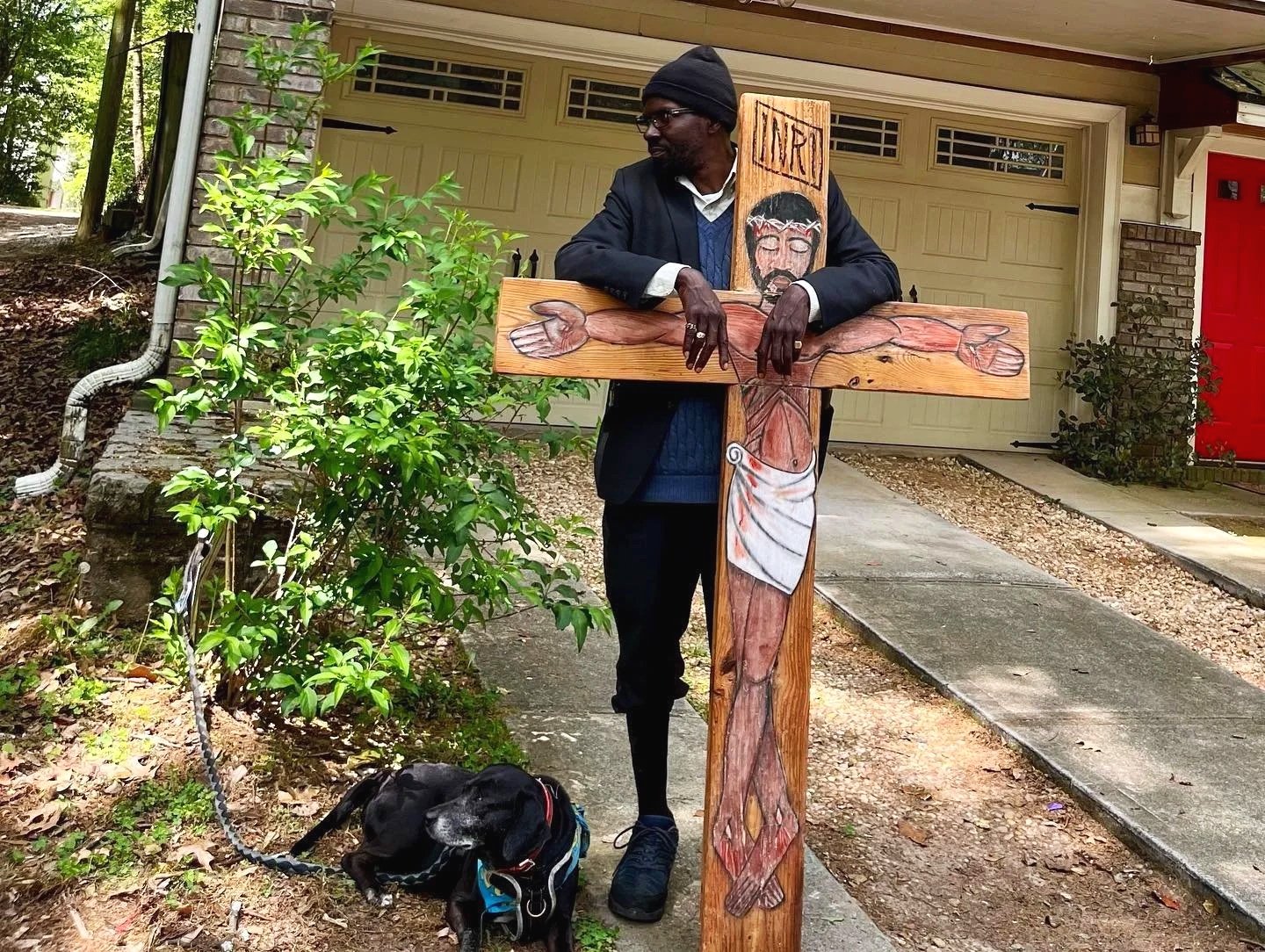
STOP 5
JESUS CONDEMNED AND TORTURED
THE GOSPEL: John 19:1-16
IN OUR NEIGHBORHOOD: The Library
REFLECTION: No Place to Be
Let’s be clear: Pilate is not a good guy. He’s directly responsible not only for Jesus being beaten and tortured but for sending him to his death. Pilate sits in the seat of a judge, but he doesn’t rule in favor of justice. He is nothing more than a crafty and cruel politician who surmises that this “Jesus-thing” is a political powder keg set to blow up in his face if he isn’t careful. He’s afraid, pure and simple.
The politicians on the other side of the aisle, the chief priests and the elders? They’re just as bad. They see Jesus as a challenge to their authority and have decided it’s best for all to get rid of him. So they make up bogus charges and lay the problem of Jesus at Pilate’s door.
Last year, when we stood on this same spot, we lauded the library: a pastor in our neighborhood once said this library ought to put a cross on its roof—because the sanctuary it provides for our sisters and brothers on the street is far more than most of our churches. But today the library is under new management. They no longer allow us to offer food to our community in their parking lot. So we do it here, where we stand, at the edge of the streets. If folks come out to eat, they have to take their belongings with them, even if they are coming right back. What might seem like simple rules have a clear target: those of us who have nowhere else to go.
That’s bad news for the library and other public institutions. And it’s an indictment against us, the followers of Jesus. Our actions—or rather, the lack of them—shout “crucify” even as the sound of “hosanna” fades from our lips. Like Pilate and the chief priests and the elders, we’re afraid. We too are only looking out for our own interests.
STOP 6
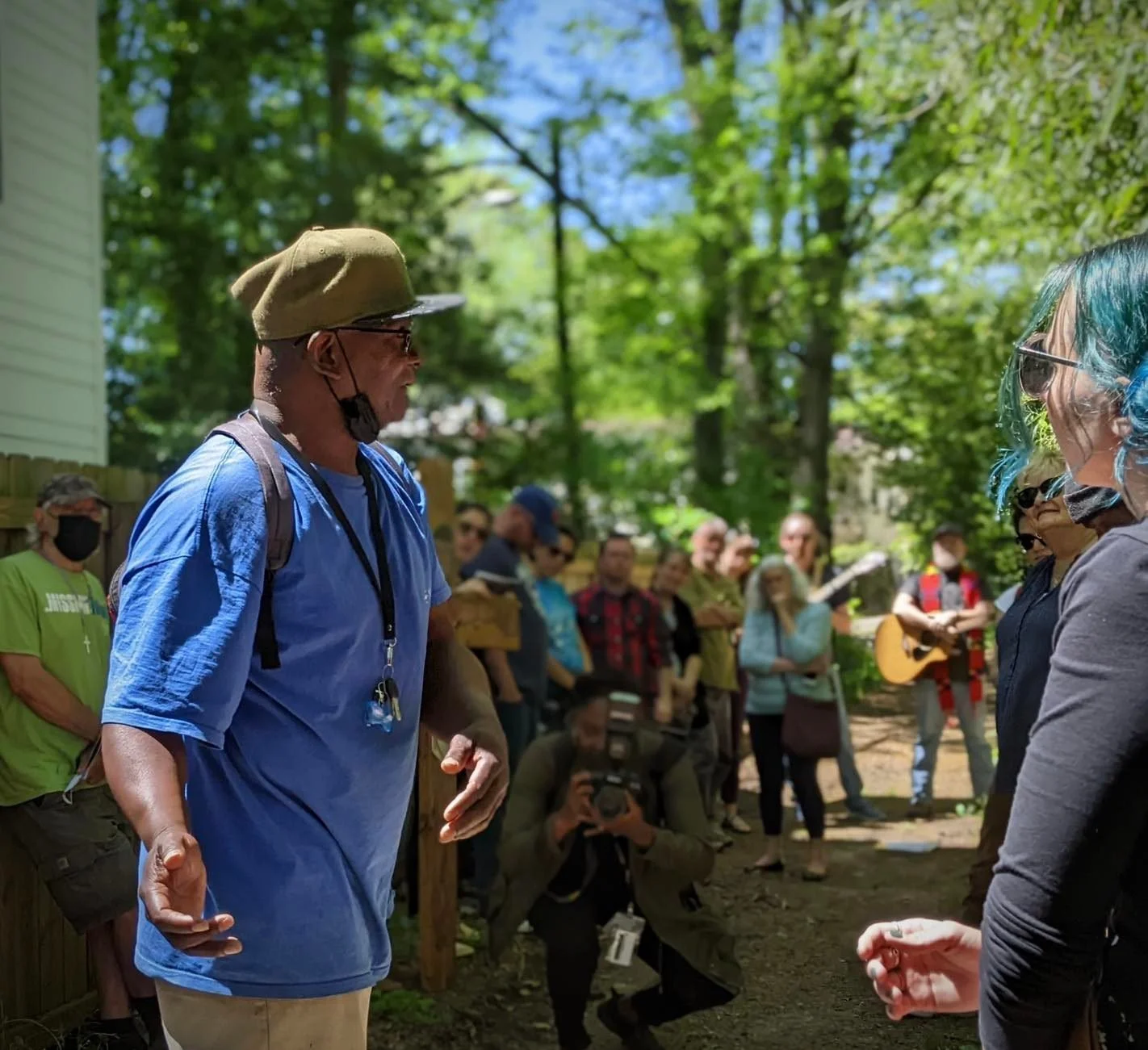
IN OUR NEIGHBORHOOD: The Back Alley
REFLECTION: Herman’s Reflections

STOP 7
JESUS IS CRUCIFIED
THE GOSPEL: John 19:17-30
IN OUR NEIGHBORHOOD: The Gates at “Old Mercy”
REFLECTION: We Encounter Death
Never will I forget the sound of it. Like a great big hammer, over and over. Five savage blows, feeling like the world was shaking apart. And then as suddenly as we were shattered, it was finished.
I knew immediately what it was, what it had to be. But my brain rebelled. How could that sound be gunshots—gunshots at our church?
Outside, we found Jason on the ground, his precious life bleeding out on this concrete, his eyes looking for comfort in ours.
Since we started it, our walk with the cross has always stopped at a place where someone in our community died: an abandoned house that burned one night while some of us slept there. A ministry house across the way that also burned as a man sought warmth in the cold. In the past few years, we stopped where our friends, the Open Door, used to be—because their absence has felt like a death for us, too.
I never thought it would stop here, outside the gates where our community once gathered.
In his mercy, Jesus unmasks our violence. Violence against the poor because Jesus was poor. Violence against prophets and those who have another world in view because Jesus was a prophet—-and like Martin, he too had a dream. Violence against the innocent because Jesus, just like Jason, was guilty of no crime. At the cross, the world—with all its damnable lies about power and might—strikes something that shatters it, breaking it apart, grace upon grace, until it crumbles to dust, and we are free at last.
As we stand here with Jesus—and Jason—let us, like John with Mary, take one another home. Let us make our community a safe place and a sanctuary for every one of us once more.

STOP 8
JESUS IS BURIED
THE GOSPEL: John 19:31-42
IN OUR NEIGHBORHOOD: With the Sisters of Charity

“The cross of Jesus unmasks all the ways violence strikes at the heart of our humanity.
By his death, Jesus jams his own body in the spokes of the wheel, stopping the machinery of violence that crushes every one of us—and breaks the cycle, once and for all.”
— Chad Hyatt